
WyattEllison
About WyattEllison
Free casino offers in Great Britain: how the market works now
We have spent weeks looking at how promotional mechanics function within the regulated British gambling space. The term free casino appears frequently in search queries, yet it rarely describes a standalone product category that exists outside standard licensing frameworks. Instead, it points to bonus-led incentives or no-deposit style offers that operators use to attract new players. Our team examined the current landscape to understand what these promotions actually entail for someone sitting in London or Manchester.
The Gambling Commission serves as the statutory regulator for commercial gambling in Great Britain. Any online casino operator serving GB must hold a valid licence from this body. This requirement ensures that even when a player accesses a site through a promotional offer, the underlying platform adheres to strict safety and fairness standards. We found that the distinction between real money play and bonus play is often thinner than marketing materials suggest.
Understanding the legal backdrop helps clarify why certain offers look the way they do. The Gambling Act 2005 provides the main legislative foundation, while the Gambling (Licensing and Advertising) Act 2014 extended licensing requirements to remote operators targeting GB. These laws dictate that age and identity verification must occur before a player can access games, regardless of whether they are using their own funds or a promotional balance. Our test confirmed that verification checks happen early in the process, which protects both the operator and the user.
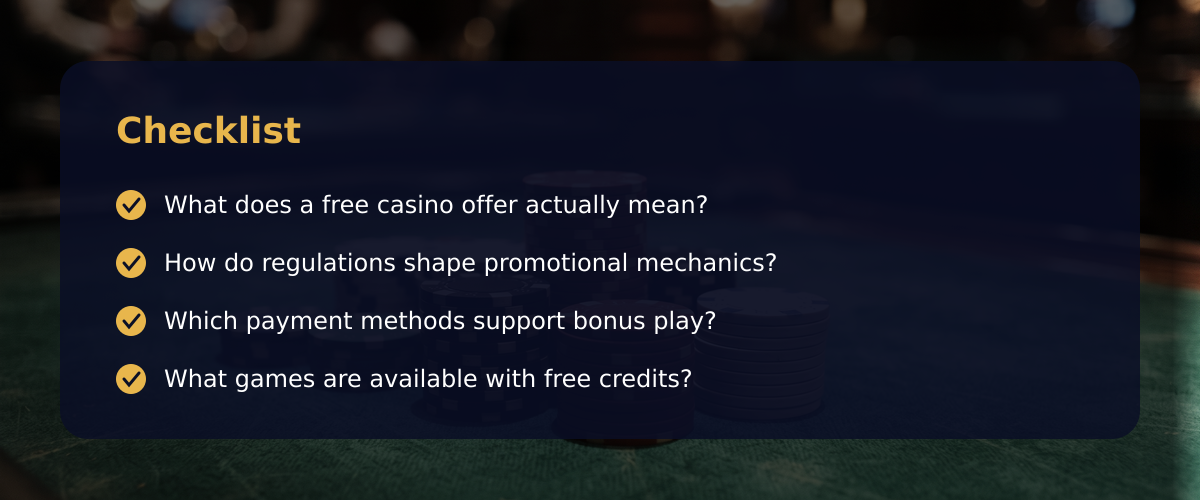
What does a free casino offer actually mean?
In the GB market, writing about a free casino usually refers to bonus-led or no-deposit-style casino offers rather than a separate regulated product category. Players might encounter free spins or small bonus credits upon registration. These tools allow users to try games without risking their own capital immediately. However, the term free can be misleading if one assumes there are no strings attached. Wagering requirements often apply, meaning players must bet the bonus amount a specific number of times before withdrawing any winnings.
We observed that operators structure these offers to comply with affordability checks and responsible gambling guidelines. A player cannot simply create multiple accounts to harvest bonuses. The system links identity documents to prevent such abuse. This means that while the initial entry might feel costless, the operational reality involves strict adherence to terms and conditions. Our team noted that transparency varies between brands, but the regulatory floor ensures a baseline level of clarity regarding how these bonuses function.
How do regulations shape promotional mechanics?
The Gambling Commission introduced a £5 maximum stake for online slots for all adults on 9 April 2025. This rule applies regardless of whether the player is using deposited funds or bonus credits. For adults aged 18 to 24, the limit is even lower at £2, a measure that went live on 21 May 2025. These caps influence how free offers are structured because operators must ensure that bonus play does not circumvent stake limits. We saw that game interfaces clearly display these limits during play sessions.
Operators licensed in GB must participate in GAMSTOP, the national self-exclusion scheme for online gambling in Great Britain. This requirement extends to players who sign up via free offers. If a person has excluded themselves through GAMSTOP, they cannot access these promotional balances. Our test verified that exclusion lists are checked in real time during the registration phase. This integration ensures that vulnerable individuals are protected even when attracted by no-cost entry points.
Which payment methods support bonus play?
When players eventually move from bonus funds to real money, they need reliable payment options. Debit cards remain a dominant choice in the UK due to their widespread acceptance and ease of use. PayPal and Apple Pay also feature prominently because they offer speed and an additional layer of security. Paysafecard provides a prepaid alternative for those who prefer not to link bank details directly to gambling sites. Credit cards are banned for gambling in the UK, so they never appear as a funding option for these transactions.
We tested the deposit and withdrawal flows associated with converting bonus winnings into cash. The process typically requires the player to verify their identity first. Once verified, withdrawals to debit cards or digital wallets proceed smoothly. Operators must adhere to anti-money laundering rules, which means large wins from free offers may trigger additional checks. Our experience showed that these checks are standard procedure and do not indicate suspicion, but rather compliance with financial regulations.
What games are available with free credits?
Slots dominate the selection of games eligible for free spins or bonus credits. This aligns with market data showing that the Remote Casino, Betting and Bingo sector made up 46% of the GB market by Gross Gambling Yield in the year to March 2025. Players often find that table games like blackjack or roulette contribute less to wagering requirements or are excluded entirely. This restriction encourages engagement with slot titles, which generate higher revenue for operators.
Football and horse racing betting sections sometimes offer free bets, but these differ from casino bonuses. Casino-specific free offers usually restrict play to slot machines or specific live dealer tables. We noticed that popular titles from major software providers are commonly included in these promotions. The variety ensures that players can explore different themes and mechanics without financial risk. However, the contribution rates vary, so reading the terms is essential to understand which games count towards clearing the bonus.
How significant is the online gambling market?
The scale of the industry provides context for why operators invest heavily in free offers. The customer-facing gambling industry in Great Britain generated £17.5 billion in Gross Gambling Yield in the financial year April 2025 to March 2026. Online gambling GGY in GB was £1.49 billion in April to June 2025 alone. These figures demonstrate the substantial economic activity within the sector. Free serves as a gateway to this vast market, allowing operators to acquire customers who might otherwise hesitate to deposit.
Online bets and spins in GB reached 27.4 billion in October to December 2025. Average monthly active online accounts in GB were 12.7 million in the same period. Such high engagement levels mean that competition for new players is fierce. Promotional offers help brands stand out in a crowded field. Our analysis suggests that while the initial offer attracts attention, retention depends on the quality of the gaming experience and the fairness of ongoing promotions. You can read more about specific platforms like riderbet casino to see how different operators structure their welcome packages.
Are winnings from free offers taxable?
A common question among British players concerns the tax status of gambling winnings. Winnings from gambling are generally not subject to UK income tax for players. This rule applies whether the funds originated from a deposit or a free bonus. The tax burden falls on the operator through duties on Gross Gambling Yield, not on the individual punter. This simplifies the financial outcome for players, as they keep whatever they manage to withdraw after meeting wagering requirements.
However, professional gamblers may face different considerations, though this is rare for typical casino players. For the vast majority of users engaging with free casino offers, the net result is tax-free. We confirmed this with current HMRC guidelines, which maintain the longstanding position that gambling is not a trade for most participants. This clarity allows players to focus on the entertainment value rather than complex tax calculations.
What risks should players watch for?
While free offers provide low-risk entry, they can encourage excessive play if not managed carefully. Affordability checks are now standard across licensed operators. These assessments monitor spending patterns and may prompt interventions if behavior suggests harm. Players should view these checks as protective measures rather than inconveniences. Our test showed that these systems operate in the background, triggering only when specific thresholds are met.
Self-exclusion tools like GAMSTOP offer a robust safety net for those who feel they are losing control. Since operators must participate in this scheme, blocking access is effective across all licensed sites. We advise players to familiarize themselves with these tools before signing up for any offer. Responsible gambling is a shared responsibility, but the regulatory framework places significant obligations on operators to facilitate safe play. Ignoring these safeguards can lead to negative outcomes, so vigilance is key.
How do we evaluate the true value?
Assessing a free casino offer requires looking beyond the headline figure. A large number of free spins means little if the wagering requirements are prohibitive. We calculate the effective value by considering the game contribution rates and the maximum win caps. Some offers limit the amount one can withdraw from bonus winnings, which significantly reduces their utility. Our team scrutinizes these details to provide a realistic picture of what players can expect.
The quality of the user interface also plays a role in the overall experience. A clunky site can frustrate players even if the bonus is generous. We test navigation, load times, and mobile compatibility to ensure that the platform supports enjoyable play. Security features like two-factor authentication add another layer of protection. These elements combine to form the total value proposition, which extends far beyond the initial free credit.
(Bonus terms often hide in plain sight; always read the fine print.)
The British online gambling market operates under a rigorous regulatory regime that prioritizes player protection. Free casino offers serve as marketing tools within this framework, providing entry points for new users while adhering to strict rules on stakes, verification, and self-exclusion. Understanding the mechanics behind these promotions helps players make informed decisions. We recommend approaching every offer with a clear understanding of the terms and a commitment to responsible play. The industry continues to evolve, but the core principles of safety and fairness remain constant under the watch of the Gambling Commission.
No listing found.
